



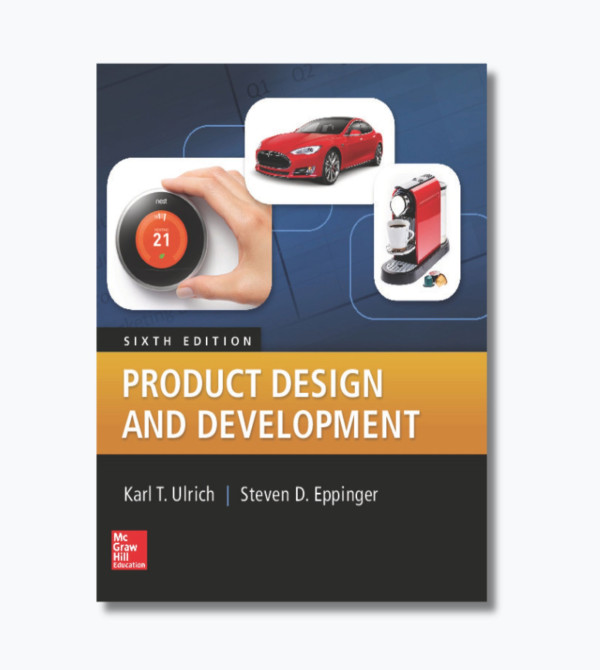

This book contains material developed for use in the interdisciplinary courses on product development that we teach. Participants in these courses include graduate students in en- gineering, industrial design students, and MBA students. While we aimed the book at in- terdisciplinary graduate-level audiences such as this, many faculty teaching graduate and undergraduate courses in engineering design have also found the material useful. Product Design and Development is also for practicing prof...
This book contains material developed for use in the interdisciplinary courses on product development that we teach. Participants in these courses include graduate students in en- gineering, industrial design students, and MBA students. While we aimed the book at in- terdisciplinary graduate-level audiences such as this, many faculty teaching graduate and undergraduate courses in engineering design have also found the material useful. Product Design and Development is also for practicing professionals. Indeed, we could not avoid writing for a professional audience, because most of our students are themselves profes- sionals who have worked either in product development or in closely related functions.
This book blends the perspectives of marketing, design, and manufacturing into a single approach to product development. As a result, we provide students of all kinds with an appreciation for the realities of industrial practice and for the complex and essential roles played by the various members of product development teams. For industrial prac- titioners, in particular, we provide a set of product development methods that can be put into immediate practice on development projects.
A debate often heard in the academic community relates to whether design should be taught primarily by establishing a foundation of theory or by engaging students in loosely supervised practice. For the broader activity of product design and development, we reject both approaches when taken to their extremes. Theory without practice is ineffec- tive because there are many nuances, exceptions, and subtleties to be learned in practical settings and because some necessary tasks simply lack sufficient theoretical underpin- nings. Practice without guidance can too easily result in frustration and fails to exploit the knowledge that successful product development professionals and researchers have accumulated over time. Product development, in this respect, is like sailing: proficiency is gained through practice, but some theory of how sails work and some instruction in the mechanics (and even tricks) of operating the boat help tremendously.
We attempt to strike a balance between theory and practice through our emphasis on methods. The methods we present are typically step-by-step procedures for completing tasks, but rarely embody a clean and concise theory. In some cases, the methods are sup- ported in part by a long tradition of research and practice, as in the chapter on product development economics. In other cases, the methods are a distillation of relatively recent and ad hoc techniques, as in the chapter on design for environment. In all cases, the methods provide a concrete approach to solving a product development problem. In our experience, product development is best learned by applying structured methods to ongo- ing project work in either industrial or academic settings. Therefore, we intend this book to be used as a guide to completing development tasks either in the context of a course project or in industrial practice.
An industrial example or case study illustrates every method in the book. We chose to use different products as the examples for each chapter rather than carrying the same example through the entire book. We provide this variety because we think it makes the
book more interesting and because we hope to illustrate that the methods can be applied to a wide range of products, from industrial equipment to consumer products.
We designed the book to be extremely modular—it consists of 19 independent chap- ters. Each chapter presents a development method for a specific portion of the product development process. The primary benefit of the modular approach is that each chapter can be used independently of the rest of the book. This way, faculty, students, and practi- tioners can easily access the material they find most useful.
This sixth edition of the book includes a new chapter on design of services, as well as updated examples and data. We have also revised the book throughout with insights from recent research and innovations in practice.
To supplement this textbook, we have developed a Web site on the Internet. This is intended to be a resource for instructors, students, and practitioners. We will keep the site current with additional references, examples, and links to available resources related to the product development topics in each chapter. Please make use of this information via the Internet at www.ulrich-eppinger.net.
The application of structured methods to product development also facilitates the study and improvement of development processes. We hope, in fact, that readers will use the ideas in this book as seeds for the creation of their own development methods, uniquely suited to their personalities, talents, and company environments. We encourage readers to share their experiences with us and to provide suggestions for improving this material. Please write to us with your ideas and comments at ulrich@wharton.upenn.edu and eppinger@mit.edu.
Welcome to Tanto Cyber - Cybersecurity & IT Solutions! 🚀
To access all the features and facilities we provide, please log in first using your account.
By using TantoCyber.com, you agree to comply with the applicable rules for the safety and convenience of everyone.
Thank you for being part of our community! 🔒✨
Tanto Cyber: A platform sharing free eBooks & tech insights, focusing on cybersecurity and knowledge.