










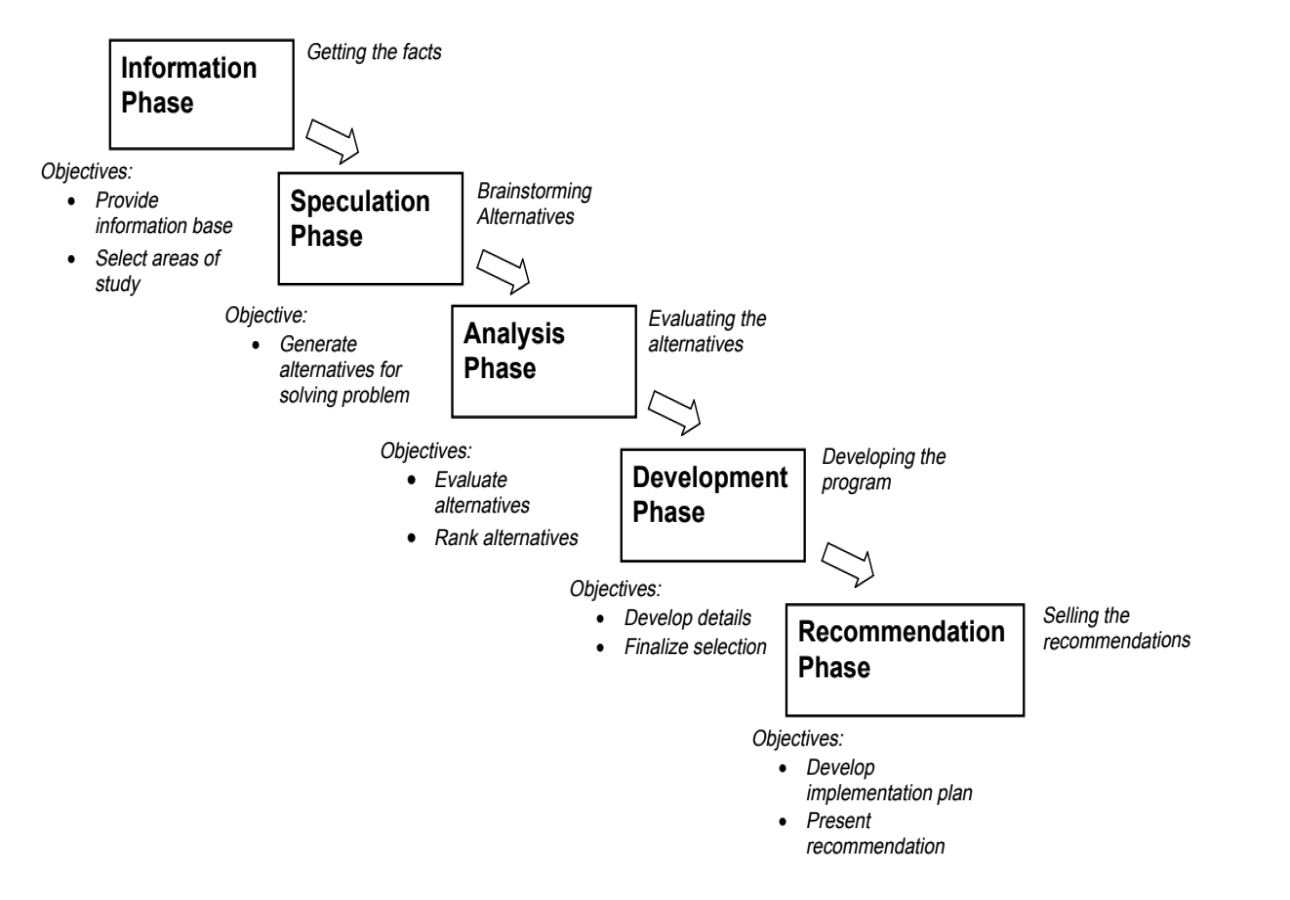
The formal approach for value engineering is often referred to as the job plan. The VE job plan comprises several phases. Generally, although there are possible variations, the following five form the essence of the job plan:
1. Information phase — Getting the facts
2. Speculation phase — Brainstorming for alternatives
3. Analysis phase — Evaluating the alternatives
4. Development phase — Developing the program
5. Recommendation phase — Selling the recommendations
Information Phase
One objective of this phase is to determine and evaluate the function(s) of the items that have the greatest potential for eliminating unnecessary costs. This answers the question “What must it do?.” The function analysis approach is one method to achieve this (Dell’Isola, 1982). It employs a verb-noun description of the function, for example, the function of a non-load-bearing wall may be defined to be “enclose space,” where enclose is the verb and space the noun. In function analysis, the focus is on why an item is necessary (i.e., its function performance) rather than on the item per se. This paves the way for substituting with cheaper alternative ways to achieve the same function(s) in the latter phases.
All the functions identified are classified as either basic or secondary. The basic function of an item is the primary purpose the item must achieve to fulfill the owner’s requirement. A secondary function, on the other hand, is not an essential feature to the owner and usually arises from a particular design configuration that makes the item look better. Sometimes, however, a secondary function may be required by regulatory or building codes. In this case, it is still a critical function essential to the performance of the item. The categorization of the functions enables costs incurred for the nonessential secondary functions to be isolated from those required to provide the basic functional performance. In this way, the number of secondary functions with its associated costs can be reduced (or eliminated) without compromising required owner’s functions. Moreover, focus can be placed on alternatives to reduce the cost of providing the basic functions.
The next objective is to determine the cost and worth of the various functions identified. The worth of an item is the lowest cost to perform the basic and required secondary functions, while nonessential secondary functions are not assigned any worth. The cost/worth ratio is an indication of the functional efficiency of the item. A high cost/worth is also indicative of the potential for reaping improvements in value.
The Function Analysis Systems Technique (FAST) originally developed by Charles Bytherway in 1965, has been widely used to determine the relationship between functions of an entire system, process, or complicated assembly. A FAST diagram gives a graphical representation of the interrelation of functions and their costs and is an excellent technique to use for this phase.
Other information required at this stage may include the following:
• Constraints that still apply at this stage
• Constraints that are unique to the system
• Frequency of use of the item
• Alternative designs considered in the earlier concept
Speculation Phase
The sole objective in this phase is to generate various alternative methods of achieving the same functions, answering the question “what else will satisfy the same needed functions?” Creative thinking techniques are used to produce as many ideas as possible. The idea in this stage is not to leave out any possible solution. Alternatives will only be evaluated in the next phase.
There are several techniques that can be adopted in this process. Brainstorming is the most popular of these. It is based on the principle that ideas are generated in large numbers if the group is diversified.
With a large number of ideas, there is an increased probability of getting good ideas. Some of these may arise spontaneously, whereas others may be derived from building upon those already proposed. At all times, no criticism or evaluation can be offered. All ideas are documented and categorized for later evaluation.
Other group techniques (Jagannathan, 1992) that can be used include:
• Checklist — The checklist comprises a set of questions or points. They provide idea clues to the VE team. For example, can the material of the item be changed?
• Morphological analysis technique — There are two steps in the technique. The first is to identify all the parameters or characteristics of the item. The next step is to seek alternatives in each characteristic. These characteristics can then be blended in a variety of ways to improve the basic performance of the item.
• Delphi method — This technique uses written questionnaires. It is advantageous in cases where participants find it difficult to attend any VE workshop session.
Analysis Phase
The objective here is to evaluate the alternatives generated in the preceding phase and select the best cost-saving alternative. This process can be difficult if there are too many alternatives in the first place.
The number of alternatives can be reduced to a manageable size using filtering (Jagannathan, 1992), where the initial ideas can be rapidly evaluated against the criteria in such filters. For example, one important filter is “safety.” Thus, if an alternative is perceived to affect safety levels adversely, it can be filtered out for later consideration. “Technology” can be another filter to defer alternatives that require technology not available in the organization and may require considerable R&D efforts.
Development Phase
This is the phase when a limited number of the ranked alternatives are taken forward for development.
The alternatives are designed in greater detail so that a better appraisal of their cost, performance, and implementation can be made. The cost should be computed based on life-cycle costing. At this stage, it may be necessary to conduct a trial or prepare a model or prototype to test the concept before recommending it to the decision-makers.
Recommendation Phase
In this phase, a sound proposal is made to management. The effort in this phase can be crucial because all the good work done thus far could be aborted at this final stage if the proposal is not effectively presented.
The presentation must also include the implementation plan so that management can be fully convinced that the change can be made effectively and successfully without detriment to the overall project.
Source: National University of Singapore
If you want to leave a comment, please log in first.





Comments